



-
PurposepiggyBAC-based doxycycline-inducible dCas9-5xSuntag-VP64 CRISPR activation plasmid for enhancer and promoter activation in mammalian cells
-
Depositing Lab
-
Depositing OrganizationUniversity of Cambridge
Located in the United Kingdom of Great Britain and Northern Ireland -
Sequence Information


Ordering
| Item | Catalog # | Description | Quantity | Price (USD) | |
|---|---|---|---|---|---|
| Plasmid | 183409 | Standard format: Plasmid sent in bacteria as agar stab | 1 | $94 | |
| DNA | 183409-D50 | 50 μg of DNA in Tris buffer | $495 | ||
| DNA | 183409-D100 | 100 μg of DNA in Tris buffer | $585 | ||
Backbone
-
Vector backbonePB510B-1
-
Backbone manufacturerSystem Biosciences
- Backbone size w/o insert (bp) 6067
- Total vector size (bp) 13630
-
Modifications to backboneThe CMV promoter (cut by SpeI and NotI) was replaced by a TRE3G promoter fragment using In-fusion cloning. Subsequently, a synthetic VP64-GB1-NLS-pA fragment was inserted downstream of the TRE3G promoter (NotI). Finally, a dCas9-5xGCN4-P2A-scFv-sfGFP fragment was inserted upstream of the VP64 and downstream of the TRE3G promoter (NotI) to reconstitute the dCas9-Suntag-VP64 transgene.
-
Vector typeMammalian Expression, CRISPR, Synthetic Biology ; piggyBAC
-
Selectable markersPuromycin
Growth in Bacteria
-
Bacterial Resistance(s)Ampicillin, 100 μg/mL
-
Growth Temperature37°C
-
Growth Strain(s)DH5alpha
-
Copy numberUnknown
Gene/Insert
-
Gene/Insert namedCas9-5xGCN5-P2A-scFV-sfGFP-VP64-GB1
-
SpeciesSynthetic
-
Insert Size (bp)6984
- Promoter TRE3G
Cloning Information
- Cloning method Gibson Cloning
- 5′ sequencing primer CTTTAGGCGTGTACGGTGGG
- 3′ sequencing primer GCACCCGTTCAATTGCCGAC
- (Common Sequencing Primers)
Resource Information
-
A portion of this plasmid was derived from a plasmid made byTetracycline controllable expression system by TET Systems
Terms and Licenses
-
Academic/Nonprofit Terms
-
Industry Terms
- Not Available to Industry
Trademarks:
- Zeocin® is an InvivoGen trademark.
DNA (Catalog # 183409-D50)
Purpose
Ready-to-use, high-purity DNA prep. DNA aliquots are suitable for use in mammalian cell transfections and other molecular biology applications.
Delivery
- Amount 50 μg
- Concentration 1 μg/μL
- Pricing $495 USD
- Storage 4 ℃ (short-term) or -20 ℃ (long-term)
Terms and Licenses
-
Academic/Nonprofit Terms
-
Industry Terms
- Not Available to Industry
Quality Control
Every DNA prep is verified by next-generation sequencing, confirming plasmid identity, sequence integrity, and absence of DNA contaminants. Concentration is confirmed to be within ±2.5% of the stated concentration.
Our production process has been validated to consistently yield endotoxin levels below 1.0 EU/μg. Individual lots are not tested for endotoxin.
DNA (Catalog # 183409-D100)
Purpose
Ready-to-use, high-purity DNA prep. DNA aliquots are suitable for use in mammalian cell transfections and other molecular biology applications.
Delivery
- Amount 100 μg
- Concentration 1 μg/μL
- Pricing $585 USD
- Storage 4 ℃ (short-term) or -20 ℃ (long-term)
Terms and Licenses
-
Academic/Nonprofit Terms
-
Industry Terms
- Not Available to Industry
Quality Control
Every DNA prep is verified by next-generation sequencing, confirming plasmid identity, sequence integrity, and absence of DNA contaminants. Concentration is confirmed to be within ±2.5% of the stated concentration.
Our production process has been validated to consistently yield endotoxin levels below 1.0 EU/μg. Individual lots are not tested for endotoxin.
These plasmids were created by your colleagues. Please acknowledge the Principal Investigator, cite the article in which the plasmids were described, and include Addgene in the Materials and Methods of your future publications.
-
For your Materials & Methods section:
pPB-Ins-TRE3Gp-dCas9-Suntag-VP64-EF1Ap-Puro was a gift from Azim Surani (Addgene plasmid # 183409 ; http://n2t.net/addgene:183409 ; RRID:Addgene_183409) -
For your References section:
Sequential enhancer state remodelling defines human germline competence and specification. Tang WWC, Castillo-Venzor A, Gruhn WH, Kobayashi T, Penfold CA, Morgan MD, Sun D, Irie N, Surani MA. Nat Cell Biol. 2022 Apr;24(4):448-460. doi: 10.1038/s41556-022-00878-z. Epub 2022 Apr 11. 10.1038/s41556-022-00878-z PubMed 35411086
Ready-to-use antibodies


Looking for antibodies related to this plasmid? Check out this option:
Learn More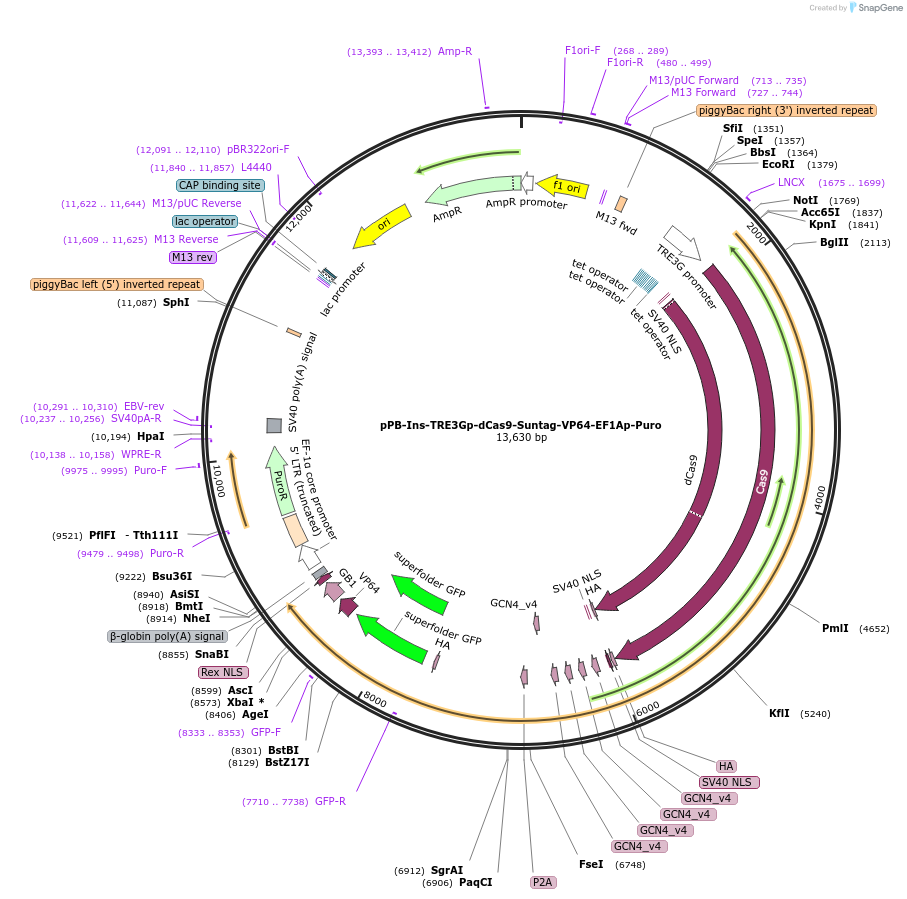
Map uploaded by the depositor.
