


MoClo Plant Parts Kit
(Kit #
1000000047
)
Depositing Labs:
Nicola Patron
This modular cloning (MoClo) collection comprises 92 standardized parts to enable Golden Gate construction of multi-gene constructs for plant transformation. 36 parts encode promoters and 5' untranslated regions; 11 parts encode antigenic tags; 8 parts encode sub-cellular localisation signals; 19 parts encode reporter genes; 6 parts encode selectable marker genes; 9 parts encode terminators and 3' untranslated regions. A suppressor of silencing and two linkers are also included.
This kit consists of one plate, and will be shipped to most countries as bacterial glycerol stocks, 96-well format, on dry ice. Samples should be frozen at -80 °C immediately upon arrival. Individual plasmids can be ordered from each plasmid page and will be shipped as bacterial stabs.
Original Publication
A Golden Gate Modular Cloning Toolbox for Plants. Engler C, Youles M, Gruetzner R, Ehnert T-M, Werner S, Jones JDG, Patron NJ, and Marillonnet S. ACS Synthetic Biology. 2014 Feb 20. doi: 10.1021/sb4001504. PubMed (Link opens in a new window)Article (Link opens in a new window)
Description
This collection comprises 92 standardized parts to enable Golden Gate construction of multi-gene constructs for plant transformation. 36 parts encode promoters and 5' untranslated regions; 11 parts encode antigenic tags; 8 parts encode sub-cellular localisation signals; 19 parts encode reporter genes; 6 parts encode selectable marker genes; 9 parts encode terminators and 3' untranslated regions. A suppressor of silencing and two linkers are also included.
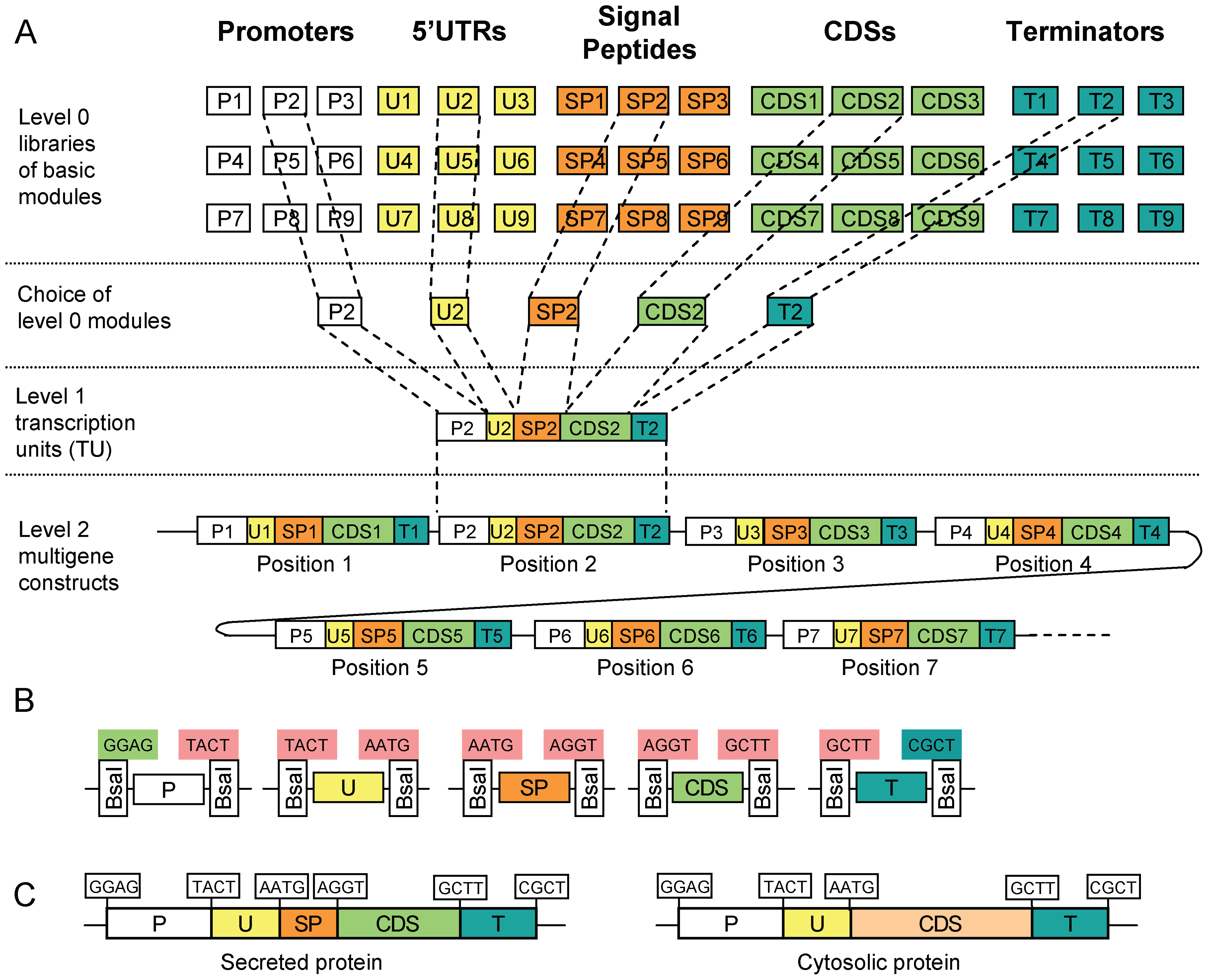
Figure 1. General overview of the hierarchical and modular cloning system. (A) Libraries of basic (level 0) modules contain cloned and sequenced genetic elements such as promoters (P), 5' untranslated regions (U), signal peptides (SP), coding sequences (CDS) and terminators (T). Transcription units are assembled from selected level 0 modules using a one-pot one-step cloning reaction. Multigene constructs are then assembled in a second cloning step (and optionally further steps) from the transcription units. (B) Level 0 modules of different classes are flanked by compatible fusion sites. Each fusion site consists of 4 nucleotides of choice (boxed) flanked by a type IIS enzyme recognition site on the left or right side (vertical box drawn under the fusion site). (C) Examples of assembled transcription units for secreted or cytosolic proteins. The transcription unit for the cytosolic protein was assembled from 4 modules rather than 5, using a CDS module cloned between fusion sites AATG and GCTT. Image from Weber et al., PLoS One. 2011 Feb 18;6(2):e16765.
Kit Documentation
Protocols
For detailed protocols, see the original publication.
For additional information browse the SYNBIO@TSL resources (Link opens in a new window)that have been developed by Nicola Patron and colleagues at The Sainsbury Laboratory.
How to Cite this Kit
These plasmids were created by your colleagues. Please acknowledge the Principal Investigator, cite the article in which they were created, and include Addgene in the Materials and Methods of your future publications.
For your Materials and Methods section: "The MoClo Plant Parts Kit was a gift from Nicola Patron (Addgene kit # 1000000047) ; http://n2t.net/addgene:1000000047 ; RRID:Addgene_1000000047).
A Golden Gate Modular Cloning Toolbox for Plants. Engler C, Youles M, Gruetzner R, Ehnert T-M, Werner S, Jones JDG, Patron NJ, and Marillonnet S. ACS Synthetic Biology. 2014 Feb 20. doi: 10.1021/sb4001504. PubMed (Link opens in a new window)Article (Link opens in a new window)
MoClo Plant Parts Kit - #1000000047
- Resistance Color Key
Each circle corresponds to a specific antibiotic resistance in the kit plate map wells.
- Inventory
Searchable and sortable table of all plasmids in kit. The Well column lists the plasmid well location in its plate. The Plasmid column links to a plasmid's individual web page.
- Kit Plate Map
96-well plate map for plasmid layout. Hovering over a well reveals the plasmid name, while clicking on a well opens the plasmid page.
Resistance Color Key
| Spectinomycin |
Inventory
| Well | Plasmid | Resistance |
|---|---|---|
| A / 1 | pICH41373 |
|
| A / 3 | pICH51277 |
|
| A / 4 | pICH45234 |
|
| A / 6 | pICH78133 |
|
| A / 7 | pICSL30008 |
|
| A / 8 | pICSL50007 |
|
| A / 9 | pICSL50004 |
|
| A / 10 | pICH49477 |
|
| A / 11 | pICSL80016 |
|
| A / 12 | pICH44300 |
|
| B / 1 | pICH41388 |
|
| B / 2 | pICH45125 |
|
| B / 3 | pICH51288 |
|
| B / 4 | pICH45244 |
|
| B / 5 | pICH41402 |
|
| B / 6 | pICH78141 |
|
| B / 7 | pICSL30009 |
|
| B / 8 | pICSL50009 |
|
| B / 9 | pICSL50011 |
|
| B / 10 | pICSL80004 |
|
| B / 11 | pICSL70002 |
|
| B / 12 | pICH77901 |
|
| C / 1 | pICH45089 |
|
| C / 2 | pICH45131 |
|
| C / 3 | pICSL12006 |
|
| C / 4 | pICH45214 |
|
| C / 5 | pICH44199 |
|
| C / 6 | pAGM5331 |
|
| C / 7 | pICSL30004 |
|
| C / 8 | pICSL50010 |
|
| C / 10 | pICSL80001 |
|
| C / 11 | pICSL70004 |
|
| C / 12 | pICH77911 |
|
| D / 1 | pICH42211 |
|
| D / 3 | pICH87633 |
|
| D / 4 | pICH87655 |
|
| D / 5 | pICH44222 |
|
| D / 6 | pAGM1482 |
|
| D / 7 | pICSL30006 |
|
| D / 8 | pICSL50012 |
|
| D / 9 | pICSL50006 |
|
| D / 10 | pICH75111 |
|
| D / 11 | pICSL70005 |
|
| D / 12 | pICH41432 |
|
| E / 1 | pICH50581 |
|
| E / 2 | pICH41551 |
|
| E / 3 | pICH85281 |
|
| E / 4 | pICH71292 |
|
| E / 5 | pICH44233 |
|
| E / 6 | pAGM5355 |
|
| E / 7 | pICSL30003 |
|
| E / 8 | pICSL50013 |
|
| E / 9 | pICSL80014 |
|
| E / 10 | pICH42222 |
|
| E / 11 | pICSL70008 |
|
| E / 12 | pICH71431 |
|
| F / 1 | pICH42760 |
|
| F / 2 | pICSL13001 |
|
| F / 3 | pICH88103 |
|
| F / 4 | pICH71301 |
|
| F / 5 | pICH44188 |
|
| F / 6 | pAGM5343 |
|
| F / 7 | pICSL30010 |
|
| F / 8 | pICSL50014 |
|
| F / 9 | pICH41531 |
|
| F / 10 | pICH43844 |
|
| F / 11 | pICH41414 |
|
| F / 12 | pICH71411 |
|
| G / 1 | pICH44157 |
|
| G / 2 | pICSL13002 |
|
| G / 3 | pICH87644 |
|
| G / 4 | pICH71311 |
|
| G / 5 | pICH44179 |
|
| G / 6 | pAGM1467 |
|
| G / 7 | pICH37431 |
|
| G / 8 | pICSL50008 |
|
| G / 9 | pICSL80005 |
|
| G / 10 | pICH44022 |
|
| G / 11 | pICH72400 |
|
| G / 12 | pICH71421 |
|
| H / 1 | pICH45173 |
|
| H / 2 | pICH51266 |
|
| H / 3 | pICH45195 |
|
| H / 4 | pICH71342 |
|
| H / 5 | pAGM1479 |
|
| H / 6 | pICSL30005 |
|
| H / 7 | pICH37326 |
|
| H / 8 | pICSL50016 |
|
| H / 9 | pICSL80007 |
|
| H / 10 | pICSL80012 |
|
| H / 11 | pICH41421 |
|
| H / 12 | pAGT707 |
|