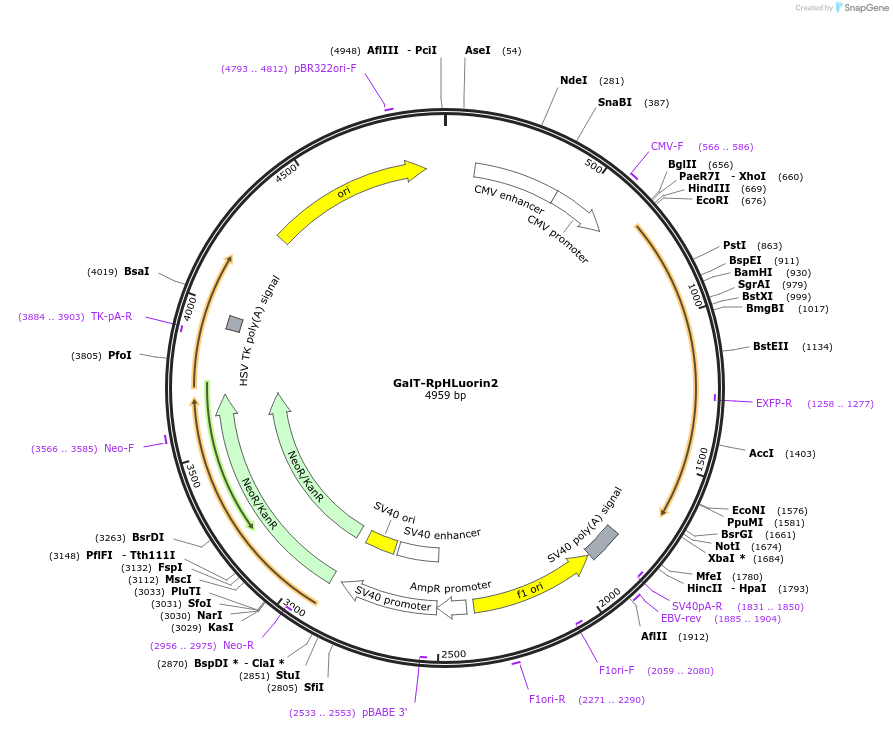
-
PurposeTrans-Golgi expression of ratiometric pHLuorin2
-
Depositing Lab
-
Depositing OrganizationUniversity of Groningen
Located in Netherlands -
Citations
-
Sequence Information
Ordering
| Item | Catalog # | Description | Quantity | Price (USD) | |
|---|---|---|---|---|---|
| Plasmid | 171719 | Standard format: Plasmid sent in bacteria as agar stab | 1 | $94 | |
| DNA | 171719-D50 | 50 μg of DNA in Tris buffer | $495 | ||
| DNA | 171719-D100 | 100 μg of DNA in Tris buffer | $585 | ||
Backbone
-
Vector backbonepRpHluorin-N1
-
Backbone manufacturerClontech
- Backbone size w/o insert (bp) 4730
-
Modifications to backboneThe starting codon of RpHLuorin2 was removed and a flexible GGSGGS linker was added between the two protein fragments.
-
Vector typeMammalian Expression
-
Selectable markersNeomycin (select with G418)
Growth in Bacteria
-
Bacterial Resistance(s)Kanamycin, 50 μg/mL
-
Growth Temperature37°C
-
Growth Strain(s)DH5alpha
-
Copy numberHigh Copy
Gene/Insert
-
Gene/Insert nameRatiometric pHLuorin2 fused to B4GALT1
-
Alt nameB4GAL-T1, CDG2D, GGTB2, GT1, GTB, beta4Gal-T1, GalT
-
SpeciesH. sapiens (human)
-
GenBank IDNM_001497.3
-
Entrez GeneB4GALT1 (a.k.a. B4GAL-T1, CDG2D, CLDLFIB, GGTB2, GT1, GTB, beta4Gal-T1)
- Promoter CMV
-
Tag
/ Fusion Protein
- ratiometric pHluorin2 (C terminal on insert)
Cloning Information
- Cloning method Restriction Enzyme
- 5′ cloning site SmaI (not destroyed)
- 3′ cloning site BamHI (not destroyed)
- 5′ sequencing primer TAACAACTCCGCCCCATT
- 3′ sequencing primer GTCCAGCTCGACCAGGATGGG
- (Common Sequencing Primers)
Resource Information
-
A portion of this plasmid was derived from a plasmid made byTruncated GalT was cloned from Addgene plasmid #87325
Terms and Licenses
-
Academic/Nonprofit Terms
-
Industry Terms
- Not Available to Industry
Trademarks:
- Zeocin® is an InvivoGen trademark.
Depositor Comments
Ratiometric pHLuorin2 sequence synthesized by Genscript, original sequence from https://www.scirp.org/journal/paperinformation.aspx?paperid=5043
DNA (Catalog # 171719-D50)
Purpose
Ready-to-use, high-purity DNA prep. DNA aliquots are suitable for use in mammalian cell transfections and other molecular biology applications.
Delivery
- Amount 50 μg
- Concentration 1 μg/μL
- Pricing $495 USD
- Storage 4 ℃ (short-term) or -20 ℃ (long-term)
Terms and Licenses
-
Academic/Nonprofit Terms
-
Industry Terms
- Not Available to Industry
Quality Control
Every DNA prep is verified by next-generation sequencing, confirming plasmid identity, sequence integrity, and absence of DNA contaminants. Concentration is confirmed to be within ±2.5% of the stated concentration.
Our production process has been validated to consistently yield endotoxin levels below 1.0 EU/μg. Individual lots are not tested for endotoxin.
DNA (Catalog # 171719-D100)
Purpose
Ready-to-use, high-purity DNA prep. DNA aliquots are suitable for use in mammalian cell transfections and other molecular biology applications.
Delivery
- Amount 100 μg
- Concentration 1 μg/μL
- Pricing $585 USD
- Storage 4 ℃ (short-term) or -20 ℃ (long-term)
Terms and Licenses
-
Academic/Nonprofit Terms
-
Industry Terms
- Not Available to Industry
Quality Control
Every DNA prep is verified by next-generation sequencing, confirming plasmid identity, sequence integrity, and absence of DNA contaminants. Concentration is confirmed to be within ±2.5% of the stated concentration.
Our production process has been validated to consistently yield endotoxin levels below 1.0 EU/μg. Individual lots are not tested for endotoxin.
These plasmids were created by your colleagues. Please acknowledge the Principal Investigator, cite the article in which the plasmids were described, and include Addgene in the Materials and Methods of your future publications.
-
For your Materials & Methods section:
GalT-RpHLuorin2 was a gift from Geert van den Bogaart (Addgene plasmid # 171719 ; http://n2t.net/addgene:171719 ; RRID:Addgene_171719) -
For your References section:
Fluorescence Lifetime Imaging of pH along the Secretory Pathway. Linders PTA, Ioannidis M, Ter Beest M, van den Bogaart G. ACS Chem Biol. 2022 Jan 21;17(1):240-251. doi: 10.1021/acschembio.1c00907. Epub 2022 Jan 10. 10.1021/acschembio.1c00907 PubMed 35000377