


-
PurposeExpresses rM3D (Gs) neuronal activator
-
Depositing Lab
-
Depositing OrganizationUniversity of North Carolina at Chapel Hill
Located in the United States of America -
Citations
-
Sequence Information

Ordering
| Item | Catalog # | Description | Quantity | Price (USD) | |
|---|---|---|---|---|---|
| Plasmid | 45549 | Standard format: Plasmid sent in bacteria as agar stab | 1 | $94 | |
| DNA | 45549-D50 | 50 μg of DNA in Tris buffer | $495 | ||
| DNA | 45549-D100 | 100 μg of DNA in Tris buffer | $585 | ||
Backbone
-
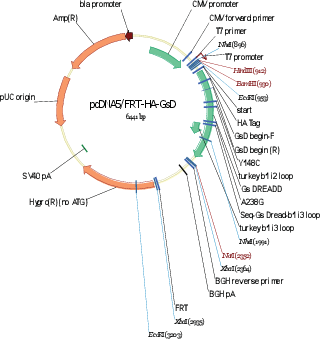
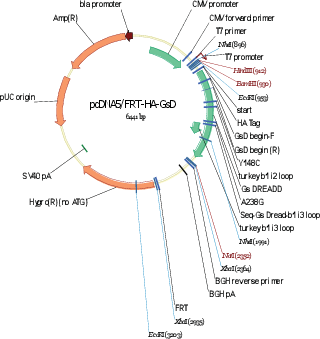
Vector backbonepcDNA5/FRT
-
Backbone manufacturerInvitrogen
- Backbone size w/o insert (bp) 5026
- Total vector size (bp) 6441
-
Vector typeMammalian Expression, Bacterial Expression
-
Selectable markersHygromycin
Growth in Bacteria
-
Bacterial Resistance(s)Ampicillin, 100 μg/mL
-
Growth Temperature37°C
-
Growth Strain(s)Top10
-
Copy numberHigh Copy
Gene/Insert
-
Gene/Insert namerM3D (Gs)
-
Alt nameHA-GsD
-
SpeciesR. norvegicus (rat)
-
Insert Size (bp)1415
- Promoter CMV
-
Tag
/ Fusion Protein
- HA (N terminal on insert)
Cloning Information
- Cloning method Restriction Enzyme
- 5′ cloning site BamHI (not destroyed)
- 3′ cloning site NotI (not destroyed)
- 5′ sequencing primer taatacgactcactataggg
- 3′ sequencing primer cctcgactgtgccttcta
- (Common Sequencing Primers)
Resource Information
Terms and Licenses
-
Academic/Nonprofit Terms
-
Industry Terms
- Not Available to Industry
Trademarks:
- Zeocin® is an InvivoGen trademark.
Depositor Comments
These plasmids were generated as part of the Illuminating the Druggable Genome (IDG) program sponsored by the NIH Common Fund. The goal of this program is to identify, gather, and distribute information and resources for proteins that currently are not well-studied yet belong to commonly drug-targeted protein families: protein kinases, non-olfactory G-protein coupled receptors (GPCRs), and ion channels. The IDG program is designed to develop fundamental research tools for understudied proteins, elucidate their function, and disseminate the IDG-related resources and data to the greater scientific community.
DNA (Catalog # 45549-D50)
Purpose
Ready-to-use, high-purity DNA prep. DNA aliquots are suitable for use in mammalian cell transfections and other molecular biology applications.
Delivery
- Amount 50 μg
- Concentration 1 μg/μL
- Pricing $495 USD
- Storage 4 ℃ (short-term) or -20 ℃ (long-term)
Terms and Licenses
-
Academic/Nonprofit Terms
-
Industry Terms
- Not Available to Industry
Quality Control
Every DNA prep is verified by next-generation sequencing, confirming plasmid identity, sequence integrity, and absence of DNA contaminants. Concentration is confirmed to be within ±2.5% of the stated concentration.
Our production process has been validated to consistently yield endotoxin levels below 1.0 EU/μg. Individual lots are not tested for endotoxin.
DNA (Catalog # 45549-D100)
Purpose
Ready-to-use, high-purity DNA prep. DNA aliquots are suitable for use in mammalian cell transfections and other molecular biology applications.
Delivery
- Amount 100 μg
- Concentration 1 μg/μL
- Pricing $585 USD
- Storage 4 ℃ (short-term) or -20 ℃ (long-term)
Terms and Licenses
-
Academic/Nonprofit Terms
-
Industry Terms
- Not Available to Industry
Quality Control
Every DNA prep is verified by next-generation sequencing, confirming plasmid identity, sequence integrity, and absence of DNA contaminants. Concentration is confirmed to be within ±2.5% of the stated concentration.
Our production process has been validated to consistently yield endotoxin levels below 1.0 EU/μg. Individual lots are not tested for endotoxin.
These plasmids were created by your colleagues. Please acknowledge the Principal Investigator, cite the article in which the plasmids were described, and include Addgene in the Materials and Methods of your future publications.
-
For your Materials & Methods section:
pcDNA5/FRT-HA-rM3D(Gs) was a gift from Bryan Roth (Addgene plasmid # 45549 ; http://n2t.net/addgene:45549 ; RRID:Addgene_45549) -
For your References section:
Evolving the lock to fit the key to create a family of G protein-coupled receptors potently activated by an inert ligand. Armbruster BN, Li X, Pausch MH, Herlitze S, Roth BL. Proc Natl Acad Sci U S A. 2007 Mar 20;104(12):5163-8. doi: 10.1073/pnas.0700293104. Epub 2007 Mar 2. 10.1073/pnas.0700293104 PubMed 17360345
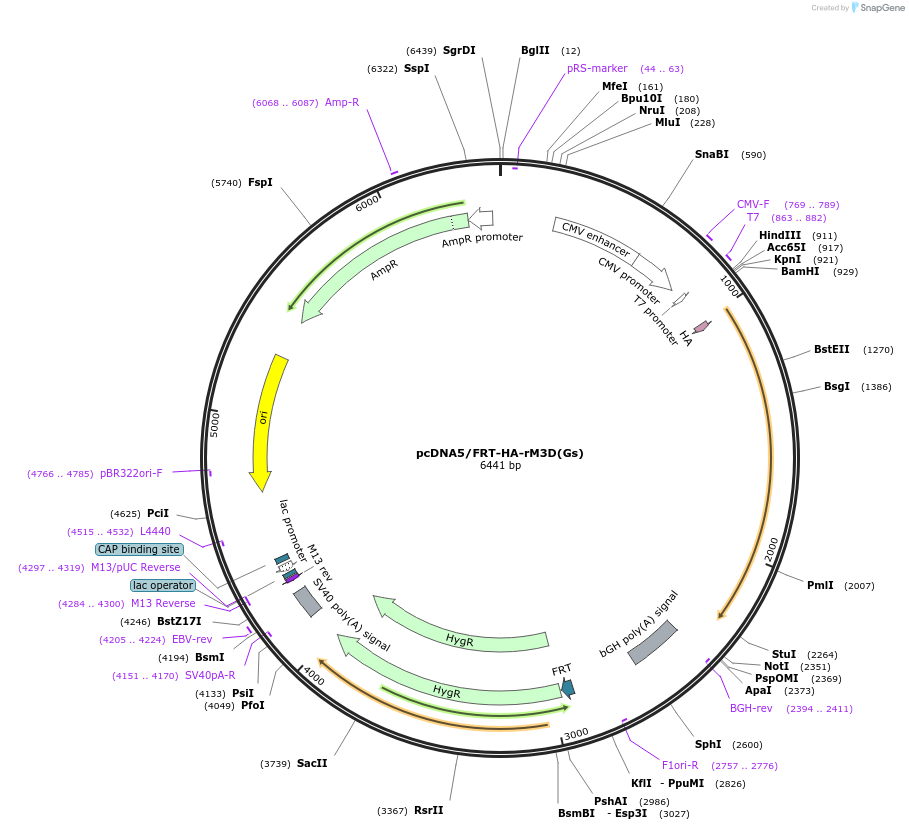
Map uploaded by the depositor.