




pPB-VPR-dSpCas9[StaPL(TI)]
(Plasmid
#111508)
-
PurposeExpresses a VPR transcriptional activator fused to the nuclease-deactivated S. pyogenes Cas9, which is governed by an inserted StaPL(TI) module, in mammalian cells. [TI = telaprevir inhibited].
-
Depositing Lab
-
Depositing OrganizationStanford University
Located in the United States of America -
Sequence Information


Ordering
| Item | Catalog # | Description | Quantity | Price (USD) | |
|---|---|---|---|---|---|
| Plasmid | 111508 | Standard format: Plasmid sent in bacteria as agar stab | 1 | $94 | |
| DNA | 111508-D50 | 50 μg of DNA in Tris buffer | $495 | ||
| DNA | 111508-D100 | 100 μg of DNA in Tris buffer | $585 | ||
Backbone
-
Vector backbonepPB
-
Backbone manufacturerSystem Biosciences
- Total vector size (bp) 13958
-
Vector typeMammalian Expression
-
Selectable markersPuromycin
Growth in Bacteria
-
Bacterial Resistance(s)Ampicillin, 100 μg/mL
-
Growth Temperature37°C
-
Growth Strain(s)DH5alpha
-
Copy numberUnknown
Gene/Insert
-
Gene/Insert nameVPR-dSpCas9[StaPL(TI)]
-
SpeciesH. sapiens (human); Hepatitis C Virus (HCV) genotype 1a, Entacmaea quadricolor, Streptococcus pyogenes, Herpes simplex virus, Epstein-Barr virus
-
Insert Size (bp)7323
-
MutationThe HCV NS3 protease carries F43L, Q80K, and S122R, and D168Y mutations. The VPR domain's internal NLS sequence was mutated to a GGSGGSGGS linker. SpCas9 contains D10A and H840A mutations.
-
GenBank IDNC_004102
- Promoter PGK
Cloning Information
- Cloning method Gibson Cloning
- 5′ sequencing primer CCACCTTCTACTCCTCCC
- 3′ sequencing primer ATTAACCCTCACTAAAGGG
- (Common Sequencing Primers)
Resource Information
-
A portion of this plasmid was derived from a plasmid made bythe Vladislav Verkhusha lab [TagBFP, Ref. 1], the George Church lab [VPR, Ref. 2], and the Stanley Qi lab [dSpCas9, Ref. 3].
Terms and Licenses
-
Academic/Nonprofit Terms
-
Industry Terms
- Not Available to Industry
Trademarks:
- Zeocin® is an InvivoGen trademark.
Depositor Comments
[Ref. 1]
SUBACH O.M., GUNDOROV I.S., YOSHIMURA M., SUBACH F.V., ZHANG J., GRUENWALD D., SOUSLOVA E.A., CHUDAKOV D.M., & VERKHUSHA V.V. 2008. Conversion of Red Fluorescent Protein into a Bright Blue Probe. Chem Biol 15 (10):1116-24.
[Ref. 2]
CHAVEZ A., SCHEIMAN J., VORA S., PRUITT B.W., TUTTLE M., P R IYER E., LIN S., KIANI S., GUZMAN C.D., WIEGAND D.J., TER-OVANESYAN D., BRAFF J.L., DAVIDSOHN N., HOUSDEN B.E., PERRIMON N., WEISS R., AACH J., COLLINS J.J. & CHURCH G.M. 2015. Highly efficient Cas9-mediated transcriptional programming. Nat Methods 12: 326-328.
[Ref. 3]
GAO Y., XIONG X., WONG S., CHARLES E.J., LIM W.A. & QI L.S. 2016. Complex transcriptional modulation with orthogonal and inducible dCas9 regulators. Nat Methods 13: 1043-1049.
DNA (Catalog # 111508-D50)
Purpose
Ready-to-use, high-purity DNA prep. DNA aliquots are suitable for use in mammalian cell transfections and other molecular biology applications.
Delivery
- Amount 50 μg
- Concentration 1 μg/μL
- Pricing $495 USD
- Storage 4 ℃ (short-term) or -20 ℃ (long-term)
Terms and Licenses
-
Academic/Nonprofit Terms
-
Industry Terms
- Not Available to Industry
Quality Control
Every DNA prep is verified by next-generation sequencing, confirming plasmid identity, sequence integrity, and absence of DNA contaminants. Concentration is confirmed to be within ±2.5% of the stated concentration.
Our production process has been validated to consistently yield endotoxin levels below 1.0 EU/μg. Individual lots are not tested for endotoxin.
DNA (Catalog # 111508-D100)
Purpose
Ready-to-use, high-purity DNA prep. DNA aliquots are suitable for use in mammalian cell transfections and other molecular biology applications.
Delivery
- Amount 100 μg
- Concentration 1 μg/μL
- Pricing $585 USD
- Storage 4 ℃ (short-term) or -20 ℃ (long-term)
Terms and Licenses
-
Academic/Nonprofit Terms
-
Industry Terms
- Not Available to Industry
Quality Control
Every DNA prep is verified by next-generation sequencing, confirming plasmid identity, sequence integrity, and absence of DNA contaminants. Concentration is confirmed to be within ±2.5% of the stated concentration.
Our production process has been validated to consistently yield endotoxin levels below 1.0 EU/μg. Individual lots are not tested for endotoxin.
These plasmids were created by your colleagues. Please acknowledge the Principal Investigator, cite the article in which the plasmids were described, and include Addgene in the Materials and Methods of your future publications.
-
For your Materials & Methods section:
pPB-VPR-dSpCas9[StaPL(TI)] was a gift from Michael Lin (Addgene plasmid # 111508 ; http://n2t.net/addgene:111508 ; RRID:Addgene_111508) -
For your References section:
StaPLs: versatile genetically encoded modules for engineering drug-inducible proteins. Jacobs CL, Badiee RK, Lin MZ. Nat Methods. 2018 Jul;15(7):523-526. doi: 10.1038/s41592-018-0041-z. Epub 2018 Jul 2. 10.1038/s41592-018-0041-z PubMed 29967496
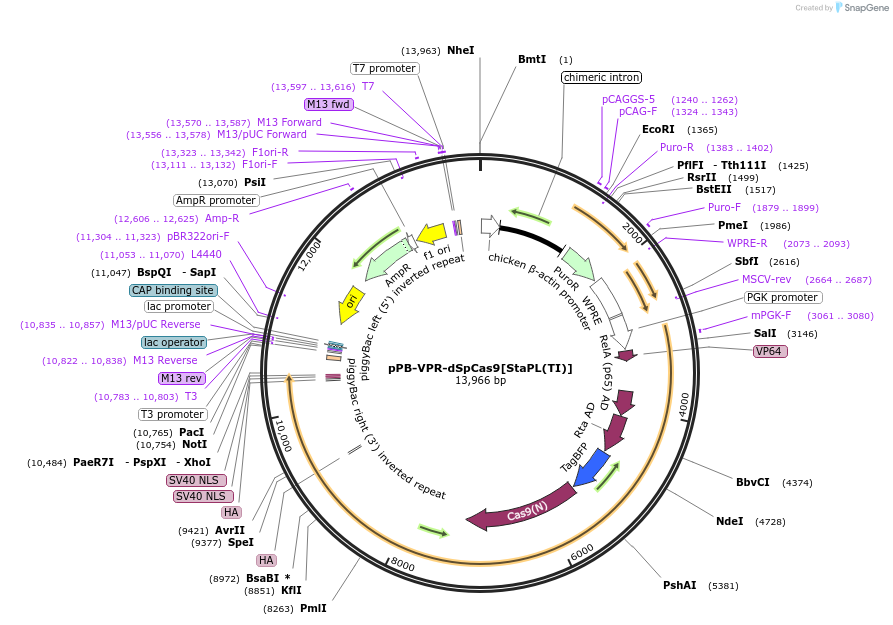
Map uploaded by the depositor.

Map uploaded by the depositor.
