user-defined upper limit for the number of target sequences returned
Alignment
region of similarity between target and query sequences
E-value
a BLAST statistic representing the significance of an alignment, values close to zero
indicate high sequence similarity with low probability of the similarity occurring by chance
Identities
the number of exact nucleotide or amino acid matches over the alignment, expressed as a fraction
and a percentage
Query Coverage
the length of the query sequence that matches the target sequence in the
alignment
Bit Score
a BLAST statistic measuring the quality of an alignment, higher values indicate a
more significant match
Span
the length of the alignment, including gaps
About Search by Sequence
Search by Sequence performs a nucleotide-nucleotide or protein-translated nucleotide BLAST search against
Addgene’s plasmid sequence database.
BLAST returns plasmids with similarity to the query sequence.
Results are sorted by E-value, a statistic from BLAST that describes the significance of a match.
Lower values are considered better matches.
FASTA headers and numbers at the beginning of each line will be removed.
The query should only contain DNA characters.
Tips for Success
Enter a distinct sequence that is an important, differentiating feature. For example, the coding region of
a gene, instead of the plasmid origin of replication.
Inspect the percent identity, query coverage, and alignment details to determine if a result match is satisfactory.
Visit the corresponding plasmid webpage to view additional details about a matching plasmid.
If no results are returned:
Try a different isoform or region of the desired sequence.
Choose a different BLAST database. Try the general “All Addgene Plasmids” (default selection),
instead of a specific database, such as “Plant Expression Plasmids”
Try selecting a different BLAST algorithm:
megablast: Designed for comparing sequences within the same, or closely related, species.
Default selection.
blastn: Designed for comparing sequences from different species. May return additional results,
if exact species match is not required.
blastn-short: Optimized for searching with shorter sequences (<= 30 nucleotides)
but can still be effective with slightly larger sequences.
tblastn: Designed for comparing protein sequences against a translated nucleotide sequence database.
Helpful for finding plasmids with codon-optimized sequences.
tblastn-fast: A faster version of tblastn that may return results more quickly, but is less sensitive
There may not be a match in our database.
You can adjust the Max Results setting on the results page from 25 to 500. If many sequences share the same top E-value,
only a truncated set of equally high-scoring matches will be shown. Set the Max Results to 500 to see more matches.
This website uses cookies to ensure you get the best experience. By continuing to use this site, you agree to the use of cookies.
Please note: Your browser does not support the features used on Addgene's website. You may not be able to create an account or request plasmids through this website until you upgrade your browser.
Learn more
Please note: Your browser does not fully support some of the features used on Addgene's website. If you run into any problems registering, depositing, or ordering please contact us at [email protected].
Learn more
Ready-to-use AAV1 particles produced from pAAV.GFAP.SF-iGluSnFR.A184S (#106192). In addition to the viral particles, you will also receive purified pAAV.GFAP.SF-iGluSnFR.A184S plasmid DNA.
GFAP-driven expression of SF-iGluSnFR.A184S. These AAV preparations are suitable purity for injection into animals.
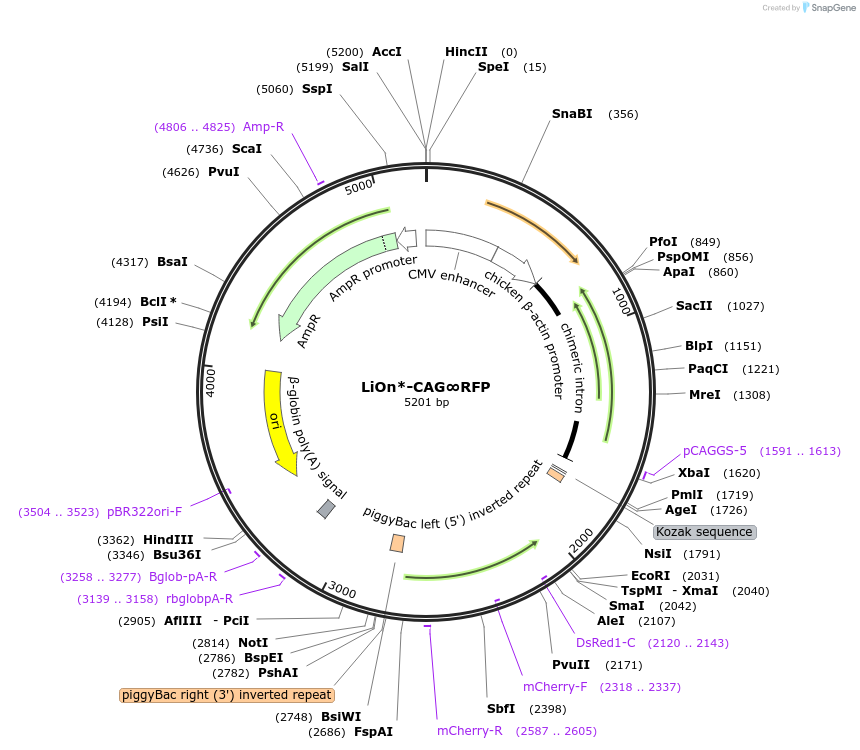
Vector based on the LiOn integration-coupled translational switch and devoid of TTAA sequences, expressing the fluorescent protein mRFP1 from a CAG promoter upon action of the piggyBac transposase
Ready-to-use AAV Retrograde particles produced from pGP-AAV-CAG-FLEX-jGCaMP7s-WPRE (#104495). In addition to the viral particles, you will also receive purified pGP-AAV-CAG-FLEX-jGCaMP7s-WPRE plasmid DNA.
CAG-driven, Cre-dependent GCaMP7s calcium sensor. These AAV were produced with a retrograde serotype, which permits retrograde access to projection neurons. These AAV preparations are suitable purity for injection into animals.
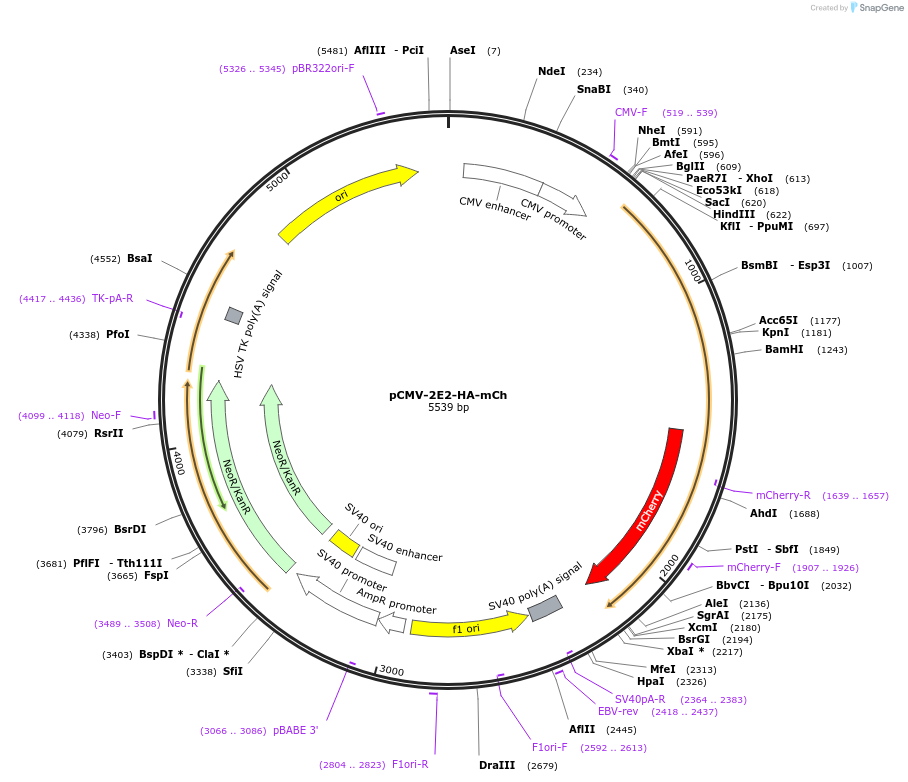
The encoded protein is the anti-HA frankenbody variant fused with the mCherry. It can be used to track mature and nascent HA tagged proteins in living organism.
Ready-to-use AAV1 particles produced from pAAV.hSynapsin.SF-iGluSnFR.S72A (#106176). In addition to the viral particles, you will also receive purified pAAV.hSynapsin.SF-iGluSnFR.S72A plasmid DNA.
hSynapsin driven SF-iGluSnFR.S72A, glutamate sensor. The S72A mutant has lower affinity for glutamate. Slower on-rate and faster off-rate. Enhanced temporal resolution and spatial resolution. These AAV preparations are suitable purity for injection into animals.
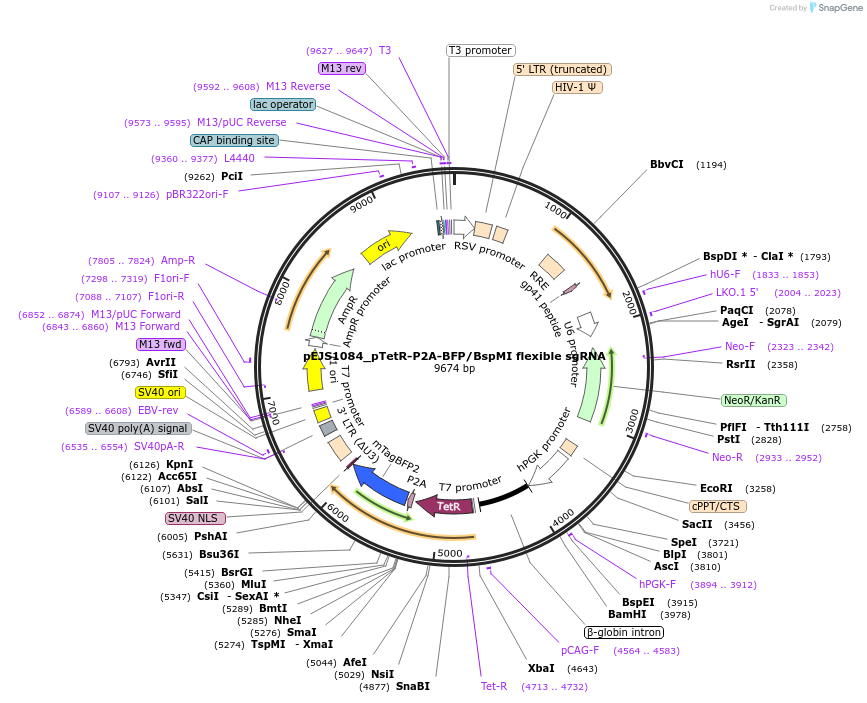
U6 driven Spy sgRNA cloning vector where guide sequences are inserted between BspMI sites. This plasmid works with Addgene #108570 for subnuclear proteomic profiling via C-BERST method.
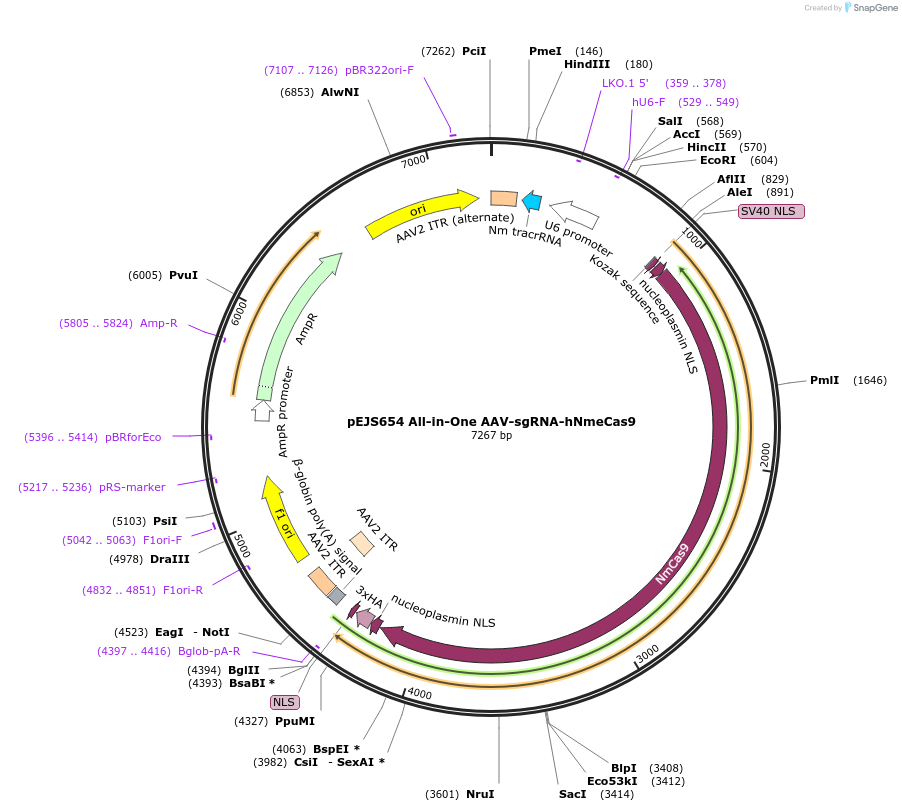
Delivery of human-codon-optimized Cas9 from Neisseria meningitidis (NmeCas9) and its single-guide RNA in a single AAV vector for in vivo genome editing.
Ready-to-use AAV9 particles produced from pAAV-double floxed-eNpHR-EYFP-WPRE-pA (#20949). In addition to the viral particles, you will also receive purified pAAV-double floxed-eNpHR-EYFP-WPRE-pA plasmid DNA.
EF1a-driven, cre-dependent eNpHR EYFP for optogenetic inhibition. These AAV preparations are suitable purity for injection into animals.
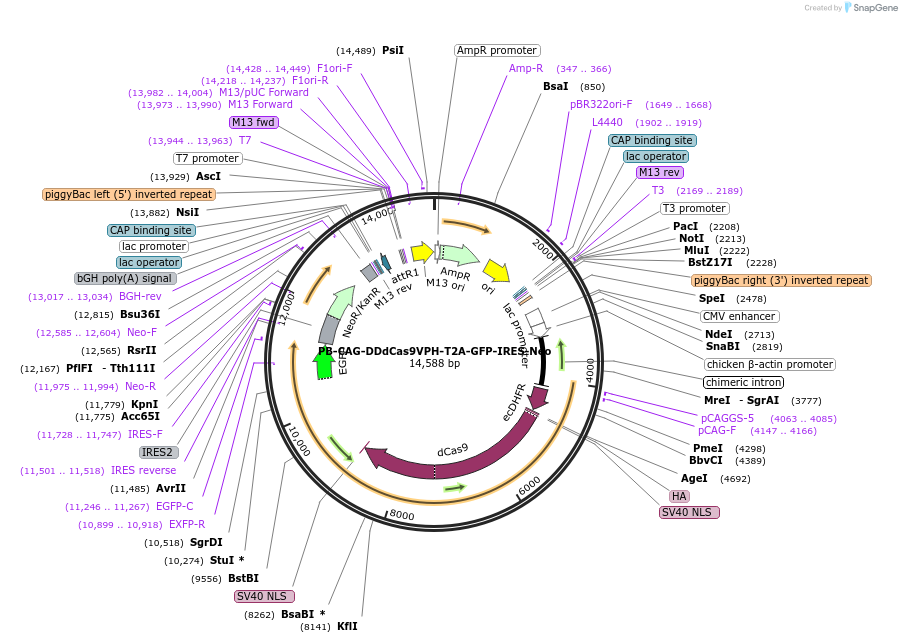
PiggyBac transposon system construct with constitutive CAG promoter expression of TMP inducible DDdCas9VP192-p65-HSF1 activator followed by T2A-EGFP as a reporter and IRES-Neo as selection
Ready-to-use AAV1 particles produced from pAAV.Syn.NES-jRGECO1b.WPRE.SV40 (#100857). In addition to the viral particles, you will also receive purified pAAV.Syn.NES-jRGECO1b.WPRE.SV40 plasmid DNA.
Syn-driven jRGECO1b calcium sensor. These AAV preparations are suitable purity for injection into animals.